Different sectors need different measures
Quality has different meanings across sectors. Assessment indicators therefore need to reflect the nature of the category being evaluated.
Institutional Ranking Framework of India
Institutional Ranking Framework of India (IRF India) is an independent research and assessment platform engaged in the ranking, rating and benchmarking of institutions, organisations and brands across India.
IRF India develops structured, sector-specific frameworks to assess performance across areas including Education, Healthcare, Business & Corporate Leadership, Real Estate, Brands and other emerging sectors.
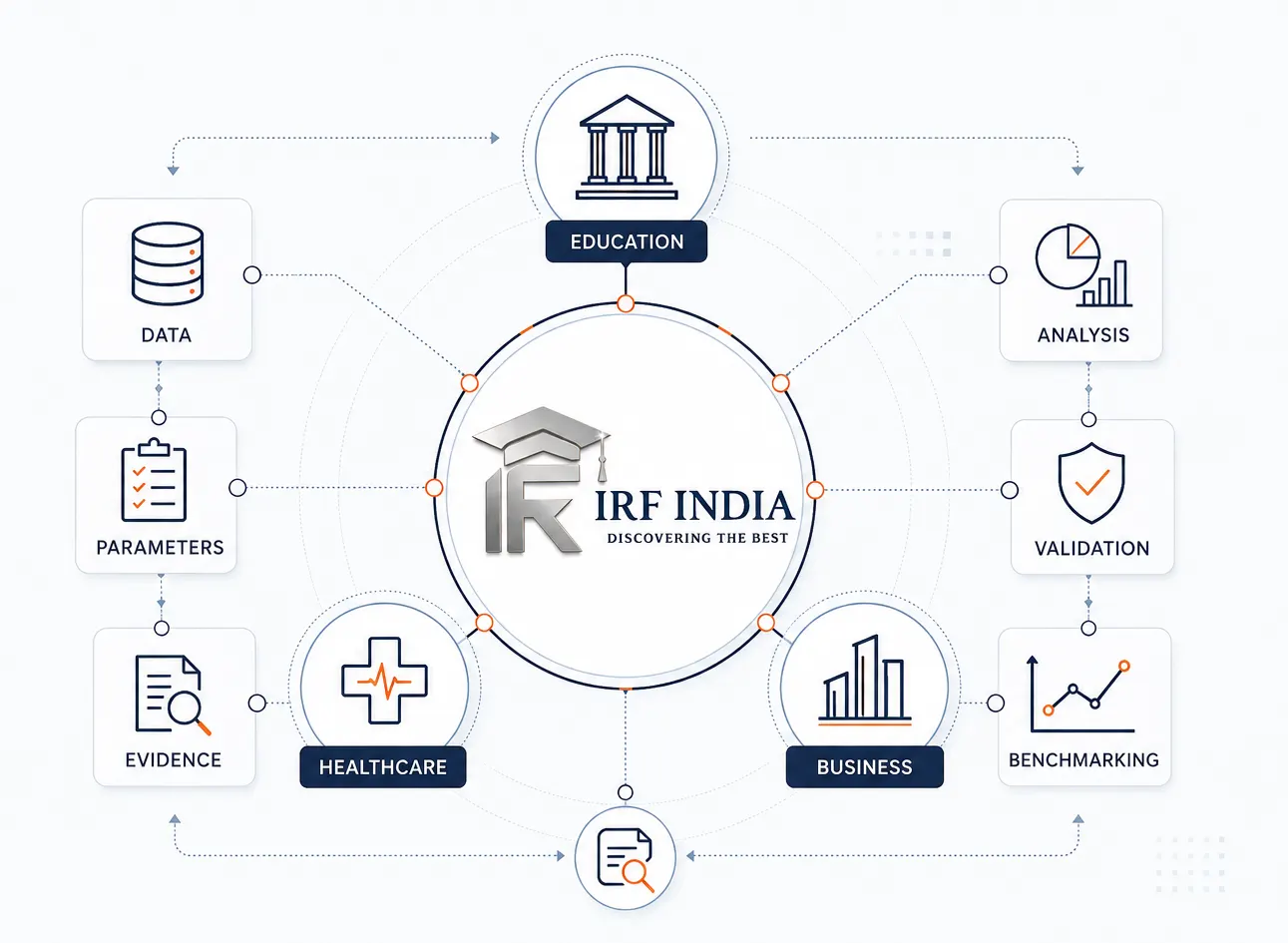
India's institutions and organisations operate in highly diverse geographical, economic and social environments. Consequently, a meaningful assessment framework must balance common principles of quality and performance with the specific characteristics of each sector and category.
A university, for example, cannot be assessed using exactly the same criteria as a hospital. The same applies to schools, business organisations, real estate developers and consumer brands.
Their objectives, operating environments, stakeholders, available evidence and measures of performance are different. The assessment framework must reflect those differences.
Understand the structure and characteristics of the sector being assessed.
Identify the institutional or organisational category and the outcomes that matter within it.
Select relevant indicators and appropriate sources of information and evidence.
Build the framework around the purpose and nature of the ranking or rating being undertaken.
A university, hospital, school, business organisation, real estate developer and consumer brand do not operate under the same conditions or produce the same outcomes.
Quality has different meanings across sectors. Assessment indicators therefore need to reflect the nature of the category being evaluated.
Meaningful assessment requires appropriate information, evidence, research methods and validation instead of relying on visibility or reputation alone.
IRF India develops assessment frameworks according to the purpose, nature and characteristics of the ranking or rating being undertaken.
The assessment starts by defining what is being measured, how it will be measured and what the resulting assessment can tell stakeholders.
The assessment begins by identifying the key dimensions of performance relevant to the sector and category.
Indicators are linked to appropriate information sources, evidence requirements and research methods.
The resulting scores, rankings or ratings are intended to provide a meaningful benchmark of performance.
Before commencing a ranking, IRF India studies the relevant sector and category to understand its structure, stakeholders, quality dimensions, context, available data, indicators and outcomes.
The findings are then translated into an assessment framework. The specific methodology, parameters and weights may differ from one ranking to another depending upon the purpose and nature of the assessment.
Important: IRF India recognises that the relative importance of parameters can differ by sector and category. The purpose is not to force every assessment into one universal formula.
IRF India develops separate frameworks for different sectors and institutional categories because quality, performance and evidence differ across contexts.
IRF India undertakes research and ranking frameworks across multiple segments of education.
IRF India develops assessment frameworks for healthcare institutions and specialised healthcare providers.
IRF India undertakes assessment of organisations and business leaders across relevant sectors.
Where leadership assessment is undertaken, the framework may additionally consider entrepreneurial contribution, strategic leadership, innovation, organisational development, ethical governance and wider industry or social contribution.
IRF India may develop separate frameworks for real estate developers, projects, agencies and other relevant participants in the real estate ecosystem.
Frameworks can be structured at either the organisation level or project level, depending upon the objective of the study.
IRF India also undertakes research and assessment of brands and consumer-facing organisations.
Brand assessment is designed according to the characteristics of the product, service or consumer category and is not necessarily equivalent to institutional ranking.
IRF India treats methodology as an evolving component of ranking research. Assessment frameworks may be reviewed when the sector, technology, regulations, data environment or stakeholder expectations change.
These principles form the foundation of IRF India's approach to institutional assessment and benchmarking.
Every assessment should have a clearly defined purpose, methodology and assessment framework.
Parameters should be relevant to the sector, category and purpose of the assessment.
Wherever possible, assessment should be supported by data, documentation or credible research.
The overall assessment should reflect multiple relevant dimensions rather than being disproportionately determined by a single indicator.
Comparison should be undertaken only among reasonably appropriate peer groups and within the limits of the available data.
Stakeholder perception can provide important insight, but should complement rather than automatically replace objective indicators.
Ranking methodologies should evolve with sectors, institutions, data availability and stakeholder expectations.
To develop a credible and independent platform for research-based institutional assessment and benchmarking in India.
IRF India seeks to contribute to a stronger culture of measurement, evidence-based evaluation, benchmarking and continuous improvement among Indian institutions and organisations.
The values below are part of IRF India's existing public positioning and are presented here in a way that connects them with the research and assessment process.
We maintain high standards in research methodology and data accuracy.
Unbiased evaluations and transparent methodologies form our foundation.
We aim to provide consistent and dependable insights for important decisions.
We develop assessment approaches in response to changing data, technology and stakeholder needs.
IRF India presents its professional affiliations, certifications and registrations as part of its institutional profile.

IRF India states that its work follows relevant MRSI guidelines for market research professionals.

IRF India presents its ISO certification as part of its quality and professional credentials.

IRF India presents its registration under the Ministry of Micro, Small & Medium Enterprises.
“Who is ranked where?” is only one part of the question.
A meaningful assessment should also help stakeholders understand:
Our objective is therefore to develop assessment systems that are methodologically structured, sector-relevant, evidence-oriented and useful to stakeholders.
IRF India
Measuring Performance. Creating Benchmarks. Recognising Excellence.
A research-oriented framework for understanding institutional and organisational performance in India.